Page 21 - 1968 VES Meteor
P. 21
V~O:L:U::_M_E_X_L_X_n_ _ _ _ _ _ _ _ _V_I_R_G_IN_I_A_E_P_ISCOPAL SCHOOL, LYNCHBURG,
VA., OCTOBER 21, 1968
NO. 1
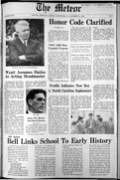
Mr. Wyatt relaxes at a recent football game.
Wyatt Assumes Duties As Acting Headmaster
movement began two years ago when there arose serious ques- tions about the utility of the old Honor System. Two trus- tees became convmced that the situation at least bore investi- gation, and so a committee was formed to research the matter and make a report to the
Senior Class Officers 1968-69 .
President-Chris McLendon Vice President-Frank Johnson Secretary-Treas.-Cecil Taylor
Junior Class Officers 1968-69
President-William Pully Vice President-Steve Shelton Secretary-Treas.-Bob Peterson
of the Choir-Glee Club is at Homecoming on October 26th. On December 8th they will per- form at the Fine Arts Center
in town on another date in the month and sing for the General Electric plant in February. The choir plans to get together with the Youth Choir of First
On August first, Mr. William L. Wyatt became acting head- master of V.E.S. Mr. Wyatt has been assistant headmaster of the school since December 1961.
J~amed to hiis new post by the executive committee of the Board of Trustees, W yatt takes the position while the board continues its search for a suc- cessor to Austin P. Montgom-
ery, Jr.
A 1938 graduate of Salem
College in Winston-Salem, N. C., Mr. Wyatt joined the V.E.S. faculty in 1946 as a history and Latin teacher. In the summers of 1960 and 1961 he was the director of the summer ses- ~ions at Christ-church School meastern Virginia. In 1967 he
, received a M.Ed. from the Uni- versity of Virginia.
. In a recent letter published m the V.E.S. Alumni N ews magazine, Wyatt expressed the hope that this period be a time when the academic program can be strengthened. "We shall be trying to make our academic
proved. In a school atmosphere filled with respect, friendliness, fairness, and firmness we should have a good academic year."
Mr. Allen
Seven New Masters Join SchoolFaculty
Mr. Allen
A new addition to the facul-
ty of V.E.S. this year is the Reverend Gordon Richard Al- len. Mr. Allen, a native of Liv- erpool, England, attended Holt College of that city.
Continued on page 4, column 1
Leckie.
The first official performance
en Hills for a program in our chapel.
departments
function ·well " " i n o r d e r th ~t
W y a t t s a i d ,
.!hrough greater co-ordination
mpia · ·
. :h nnmg and exchange of in-
~Ig ts the o~erings and quali- Y of teachmg may be im-
VES Symbol
As Harvard has its Harvard Square and Cambridge has its Magdalen Tower, thus also Vir- ginia Episcopal School has its historic bell. Being barely fifty
Yea~s old we can hardly claim a nch heritage, but the bell is one of our few links with the school's Past. The bell's in-
Pace's Warehouse
race Bros. and Co.
p879 Baltimore, Maryland .at. July 13, 1869
reads :
warehouse in Lynchburg.. At this early stage of its develop- ment, the city still lacked some of the finer things in life. Hence the bell also served as a volunteer fire department
alarm.
Eventually, when the ware-
house dissolved and Lynchburg refined its fire fighting meth- ods, the bell moved to a higher calling and came to rest in the steeple of Epiphany Episcopal
Church in Miller Park. Sadly enough the church also dis- solved. Nonetheless the bell still
remained in the church's bel- fry until several years after
Virginia Episcopal Scliool was
established.
At this point, Bishop Carter
Jett, the founder of V.E.S., tir- ing of the three dollar bell that the school had been rising to, felt that the old church bell was the answer to the school's communication problems. He approached what members of the church's vestry that could be collected and requested per- mission to move the bell. The church council seemed in full accordance at the time and a tower was readied at the school
to house the bell.
All went well until plans for
scription
J. Register and Son
With no great depth of per- cept"
bell Ion on: ~ay derive that the was ongmally cast in Balti-
more. Its first residence was a
• I
by Fielding Jones
The biggest single change on
the V.E.S. campus this year is
tha~ of the Honor System. The
maJor development is the revi-
talization . of the procedural
structure to clarify the exact
method by which the System
operates.
Choir Adds Boys, Expands Program
The Choir-Glee Club, facing an even busier schedule than last year, has added twelve
new members to its rolls. This brings the total number of members to an all-time high of thirty-six, with a waiting list
of over half a dozen.
The new members are, in
the tenors: David Bland, Tom Manning and Bill StufHebeem; the baritones: Eddie Barham, Cac Hoyle, Jim Laird, and Charlie Merritt; the basses: Hunter Beach, Bill Hill, Wooty Peebles, John Powell, and Dav-
id Smythe. This year's presi- dent is Clay Ferebee and the
The main impetus of this Board.
returning librarian is Lee Presbyterian Church and Sev-
Profile Indicates New Boy A North Carolina Sophomore
Recently the sixty-nine new away from personalities, but boys at V.E.S. underwent a asked the new boys whether survey in which they answered they were conservative, liberal, nine questions. The results or neither. In what may be taken as a most interesting re- sult, forty-five percent consid- ered themselves liberals, thirty-
eight percent conservatives, The average new boy is a and seventeen percent had no
fend himself and the aid of a "'-"~4 n g col " "
have been compiled, and may give some insight into the most recent members of our student
decision to dismiss a boy must be unanimous agreement of the headmaster and a committee composed of the chaplain and
at least four other faculty members.
Every effort to improve the legal workings of the System has been made, but its ultimate success or failure rests in the students' appreciation of the value of a viable Honor System.
• I
the actual move materialized. At the last moment several of the church fathers had second thoughts and the transfer was
temporarily forestalled. It soon became evident to Bishop Jett that he might never get the bell. Being a man of action, he was determined not to ·let this occur. Late one night, Dr. Jett, with a few friends of the school in tow, proceeded to make an assault on Epiphany Church. With the Bishop as lookout, the group removed the bell from the steeple. It was subsequent- ly placed in the school's tower,
Continued on page S, column 1
body.
sophomore (about 45 % ) and is nearly fifteen years old. His home is about two hundred miles from V .E.S. though the greatest exception to this is the lad who lives eight thou- sand miles from home. As usu-
al he lives in North Carolina. He is from an urban district with a population of seventy- five thousand. The most ex- treme exceptions are two boys, one whose community has sev- enty-five people and another whose city has over one million. A major revelation is the fact
that he is Episcopalian. Politically the survey steered
preference.
•
In the spring of 1968 a re- .port was presented to the ad- ministration and trustees. It
embodied recommendations that the Honor Code be written down and that a 'pledge to abide by it be included in me-
triculation of new boys.
All summer Mr. Wyatt worked on the first draft of the written version of the Code. In longhand it was presented to the faculty who made minor revisions in phrasing. The final copy was then distributed to the student body at the opening of school.
Perhaps then the- moral is- sue of honor is the extension of the protection offered the student. Putting the Code in relatively immutable form has for the first time established the boundaries beyond which one is in violation. Even after a student has been accused of an offense every effort is made to give him the benefit of the doubt. The administration is
not made aware of the accusa- tion unless the Honor Commit- tee feels that it may be valid.
If there is due suspicion, the
offender is given time to de-
.._,VU...L~ - v . J • I
member, of his choice. Finally,